

FCC
segments




Industrial floor coverings are subject to extreme operating conditions - such as heavy forklift traffic, storage of heavy loads, chemical spills and thermal variations.
That's why the choice of roofing system is crucial to ensuring the safety, productivity and longevity of the infrastructure. In this article, you'll find an overview of the main solutions available, with an emphasis on polyurea.
Follow us and find out more!
Industrial environments require coatings with high resistance to abrasion, impact and chemicals, as we have seen. It is also essential that they are waterproof, quick to apply and release, and allow for occasional maintenance.
The market offers a number of technologies for protecting industrial floors, each with specific characteristics. Below, we'll get to know the most common types of coating:
High-performance polyurea is a material suitable for extreme conditions. That's why it can be used as a coating for industrial floors. Learn about its main characteristics!
Polyurea has the ability to absorb impacts from falling objects or equipment traffic without cracking or chipping the coating. This resistance is maintained even at lower thicknesses, avoiding the need for multiple overlays and ensuring the integrity of the floor for long periods under continuous use.
One of the most striking advantages of polyurea is that it dries, usually within minutes or hours of application. With the rapid release of light traffic, this system drastically reduces downtime. The material is therefore ideal for plants that cannot interrupt their activities for long periods.
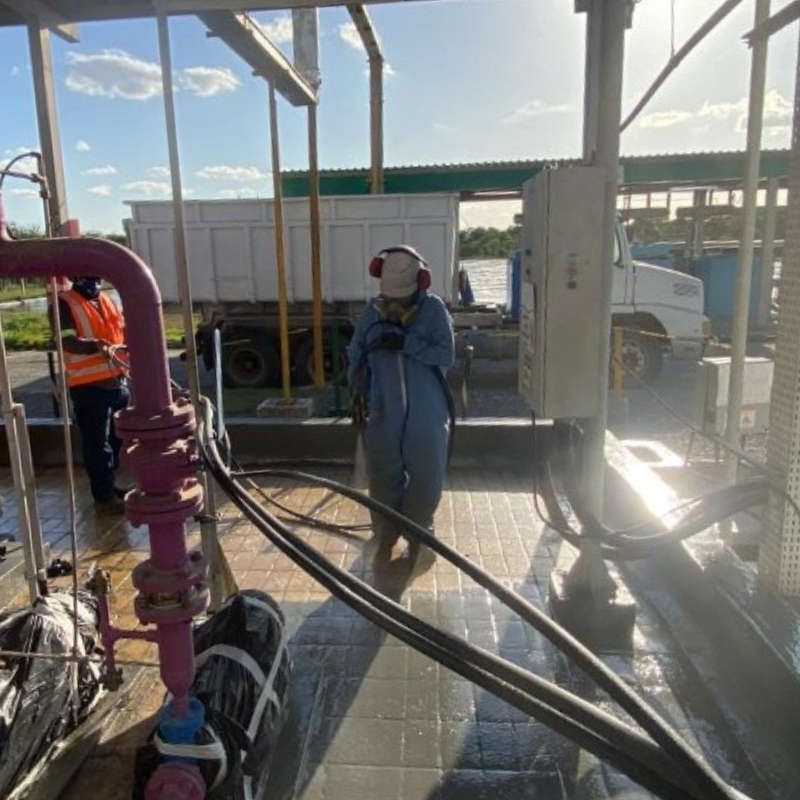
Unlike conventional systems that require several coats to achieve the desired thickness, polyurea allows thin layers to be applied in a single pass. This makes the process more agile and minimizes the occurrence of interfaces between layers, resulting in a continuous, flawless coating.
Thanks to its structure, polyurea forms an impermeable barrier to water and vapor, preventing infiltration and protecting the substrate from corrosive agents. This impermeability is essential in environments subject to constant washing or in contact with liquids, for example.
Polyurea's high degree of elasticity allows the coating to follow the natural movements and vibrations of the substrate without breaking or peeling off. This characteristic is especially important in areas subject to thermal variations or small cracks, as the material adapts without compromising coverage.
Polyurea can also withstand high tensile stresses without permanently deforming. Resistance is essential on industrial floors, where pulling and traction forces occur during the movement of machinery and equipment, preserving the integrity of the coating.
Systems with high abrasion resistance maintain their thickness and properties even under intense mechanical wear, such as the constant movement of pallets, conveyors and rollers. Polyurea thus stands out for retaining its characteristics over time, reducing the need for frequent maintenance.
The compatibility of polyurea with acids, bases and solvents in different concentrations prevents degradation of the coating and protects the substrate from chemical attack. Its resistance expands the possibilities of application in the chemical, pharmochemical and food industries.
Now that you know the most outstanding characteristics of polyurea as an industrial floor covering, check out the benefits of adopting it in your company.
Thanks to its combination of mechanical, chemical and weather resistance, polyurea offers a life cycle of more than 10 years without the need for significant repairs. This longevity reduces maintenance and replacement costs, bringing a return on investment.
.jpg)
Because it doesn't require heavy mechanical protection (such as additional layers of concrete), the polyurea system reduces the total weight applied to the infrastructure. This is particularly relevant on elevated slabs and platforms where the additional load can compromise safety.
Continuous, seamless application creates a coating that eliminates points of failure and potential leaks. This uniformity ensures a smooth surface, without unevenness, making cleaning easier and preventing the accumulation of residues.
In the event of localized damage, it is possible to cut out and add polyurea directly to the affected area, without interrupting or removing large sections of the coating. This reduces costs and intervention time.
Available in a smooth or textured finish, with a wide range of pigmentation, polyurea makes it possible to customize the look of the floor according to the client's needs, while maintaining high performance and aesthetic appeal.
The spray-designed material reaches hard-to-reach places and adapts to different geometries, including angles, corners and structural details, providing complete coverage without the need for molds.
Free of Volatile Organic Compounds (VOC) and compatible with environmental certifications such as LEED, polyurea coatings meet the requirements of sustainable projects, helping to reduce environmental impact.
Throughout this content, it has become clear that polyurea offers a robust set of advantages for industrial floor coating, such as:
But to get the full potential of this system, it is essential to rely on an experienced supplier with technical mastery and a track record of excellence in the market.
FCC is a benchmark in the development and supply of high-performance thermoplastic elastomer solutions for industry.
Since 1969 in the market, our portfolio includes highly reliable materials, developed on the basis of cutting-edge technology and technical rigor.
Our polyurea range meets the different requirements of the industrial sector, with proven applications in aggressive environments and critical infrastructure.
So if you're looking for a high-performance, durable coating with an agile application, FCC is the ideal partner.
Contact our technical team and find out how polyurea can transform the protection and efficiency of your operation's industrial floors.
