

FCC
segments


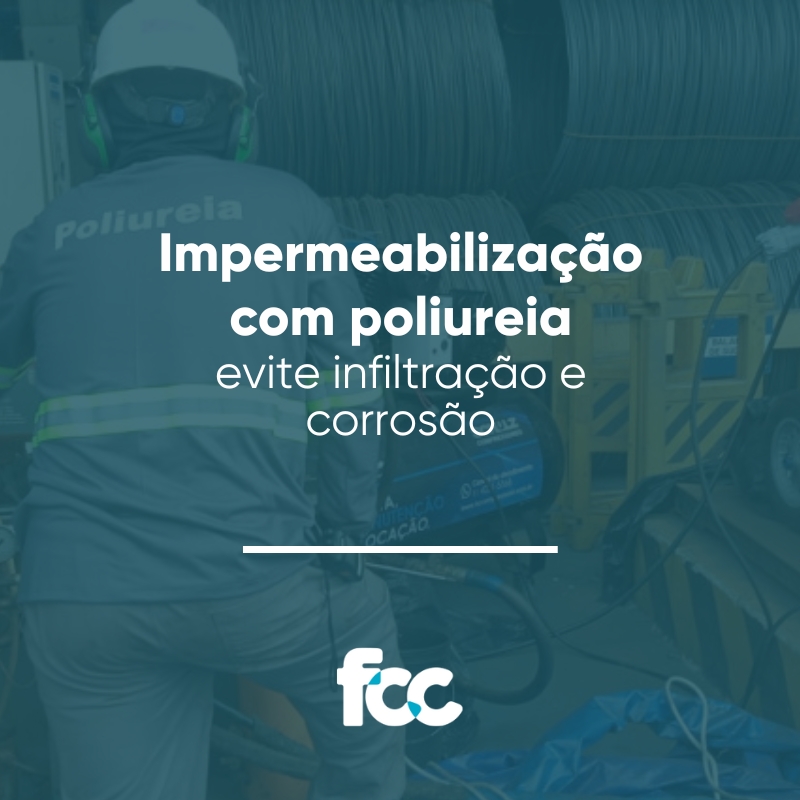


Waterproofing with polyurea is a solution increasingly adopted by companies facing infiltration and corrosion in critical places. These problems cause structural failures that compromise durability, increase costs and require corrective downtime.
For those looking for technical performance and agility in execution, polyurea is an efficient technology, capable of protecting different surfaces even in harsh conditions. Find out more about its characteristics, applications and operational advantages.
Polyurea is a high-performance elastomeric coating. Its main characteristics include:
The material is applied with a high-pressure spray, forming a continuous, elastic and resistant layer.
Polyurea waterproofing has a life expectancy of more than 10 years, reducing the need for corrective maintenance. This increases the time between interventions, benefiting the continuity of industrial processes.
The main function of polyurea is to protect materials against water and chemical agents that favor deterioration over time. Understand how it works in engineering projects and industrial environments:
Spray application reaches corners, drains, joints and other hard-to-reach areas, forming a continuous and efficient barrier. The absence of gaps between layers reduces the chance of seepage.
The composition of polyurea resists corrosive substances such as bases, solvents and acids. This prevents these agents from reaching the substrate, protecting the structure against corrosion - even in humid, aggressive or climate-changing environments.
Polyurea waterproofing can be applied to different types of work and sectors, especially when technical performance, safety and speed of execution are required.
The application forms a uniform coating, without joints or overlaps, eliminating points vulnerable to infiltration. This provides sealing even in areas with irregular geometry.
Check out examples of elastomeric coating applications:
.jpg)
In addition to technical protection, waterproofing with polyurea also provides gains in productivity and efficiency when compared to systems such as epoxy paint. Check out this comparison!
The area treated with polyurea can be cleared for operation on the same day. Epoxy paint N-2680, for example, requires up to four days to fully cure - which represents a delay and an impact on the work schedule.
Polyurea requires fewer steps, fewer professionals and less application time than epoxy. In addition, it does not require additional structures such as cranes and scaffolding, even in high areas - which can have a positive impact on the project's investment.
Over a 10-year period, areas coated with epoxy will require, on average, 5 times more maintenance and costs. Polyurea, on the other hand, only requires one intervention, with fewer operational risks, less downtime and more safety for workers.
Polyurea waterproofing is insensitive to relative humidity. As long as it is not raining during application, the work can be carried out safely. Epoxy systems, on the other hand, are highly sensitive to the weather, requiring ideal conditions and waiting periods.
The effectiveness of waterproofing depends not only on the formulation of the product, but also on the training of the team and the experience of the supplier. It is therefore essential to analyze technical criteria before choosing a solution:
There are different types of polyurea on the market, with significant variations in composition. It is essential to choose products with proven performance, tested chemical resistance and the right formulation for the intended application - such as FCC's elastomeric coatings.
The application requires qualified professionals, specific equipment and technical support at every stage of the project. Companies like FCC stand out for delivering complete solutions, with a track record of excellence and consultative assistance.
.jpg)
FCC's high-performance elastomeric coatings are more than just a sealing system. They form a protection strategy for structures that demand performance, safety and durability.
Its rapid application, chemical resistance and long service life can generate better value for money, prevent failures and increase operational efficiency.
FCC develops polyurea solutions with technical quality, specialized support and a focus on the demands of the industrial sector. So when it comes to waterproofing critical areas in your company, count on our experience.
Talk to the experts at FCC and find out how to apply polyurea to your construction site or industrial operation.
